Can a Sneaker Ever Be Sustainable?
Sneakers are one of fashion’s hardest items to fix. Made mostly from plastic and complex composites, they’ve resisted change for decades. Now a wave of innovators is rebuilding them with plant-based fibers and circular design in mind.

Sneakers are one of fashion’s hardest items to fix. Made mostly from plastic and complex composites, they’ve resisted change for decades. Now a wave of innovators is rebuilding them with plant-based fibers and circular design in mind.
Sneakers look simple, but in the world of sustainability they are one of the hardest products to fix.
That is because modern sneakers were designed around plastic, and plastic comes from oil. Once created, it does not biodegrade. At the end of their life, sneakers usually end up in landfills or are exported to lower-income countries with limited waste infrastructure, where they can take centuries to break down. During that slow decay, they shed microplastics into waterways and oceans, some of which eventually enter the food chain and now research shows that they are making their way into human bodies.
It is a global problem that scientists are only beginning to understand. And while new material innovations offer hope, most have not yet reached the scale or affordability needed to compete with plastic-based manufacturing.
Why Our Sneakers Are Made of Oil
Most sneakers today are built from petrochemical materials such as EVA foam midsoles, synthetic mesh, rubber outsoles, plastic overlays, and fossil-based adhesives. This dependence on oil wasn’t accidental. It evolved because petroleum-based materials are cheap, lightweight, and easy to shape at scale. In the mid-20th century, as mass production took hold, plastics replaced natural materials like cotton, jute, and leather in the pursuit of performance, flexibility, and profit.
Those same innovations that made sneakers comfortable and affordable also made them nearly impossible to recycle or compost. In landfill, synthetic components can take 25 to 1,000 years to break down (Unsustainable Magazine). As they degrade, they can release methane and ethylene, both potent greenhouse gases. During use, the friction of walking sheds microplastics that flow into rivers and oceans; researchers estimate that worn footwear generates between 9,000 and 400,000 metric tonnes of microplastics each year (Asparagus Magazine).
What began as a design revolution built on performance has become one of fashion’s biggest environmental challenges, and sneakers are now among the least sustainable items in our wardrobes.
Material Innovations Showing Promise

To change that, researchers and designers are experimenting with new, plant-based and biodegradable materials. Some of the most promising include:
- Bananatex: A sturdy, plastic-free fabric made from banana-plant fiber grown in the Philippines. It is fully biodegradable and requires no pesticides or fertilizers. (Bananatex)
- Piñatex: Made from pineapple-leaf fiber, a byproduct of existing agriculture. It makes smart use of waste, although the petroleum-based resin used for durability means it is not fully biodegradable. (Piñatex)
- Mycelium Leather: A material grown from mushroom root structures that mimics the look and feel of leather without animals or synthetics.
- Bamboo and Hemp: Fast-growing, renewable fibers that require little water and can be blended into strong fabrics.
- Rubi Labs CO₂ Fabric: An early-stage innovation that literally spins captured carbon from the air into textile fibers, turning pollution into material. Still experimental, but a glimpse of what is possible.
These materials are exciting, but most remain costly to produce at scale. Performance testing, supply chain readiness, and durability expectations for footwear are high, which keeps prices elevated and adoption limited.
The Scaling Challenge
Even the best new materials cannot fix how sneakers are built.
Each pair is made from multiple layers: foam, textile, rubber, glue, all bonded together. Those mixed materials make traditional recycling nearly impossible.
To achieve true circularity, brands will need to redesign sneakers from the ground up, including developing biodegradable adhesives, foams, and trims. Until then, most “sustainable sneakers” still contain some synthetic element, which means they may be better, but not fully sustainable.
The One Brand That Has Done It: Unless Collective
The most complete example so far comes from Unless Collective, founded by former Adidas executive Eric Liedtke. Their sneaker, The Degenerate, is the first verified plastic-free, plant-based, biodegradable sneaker on the market.
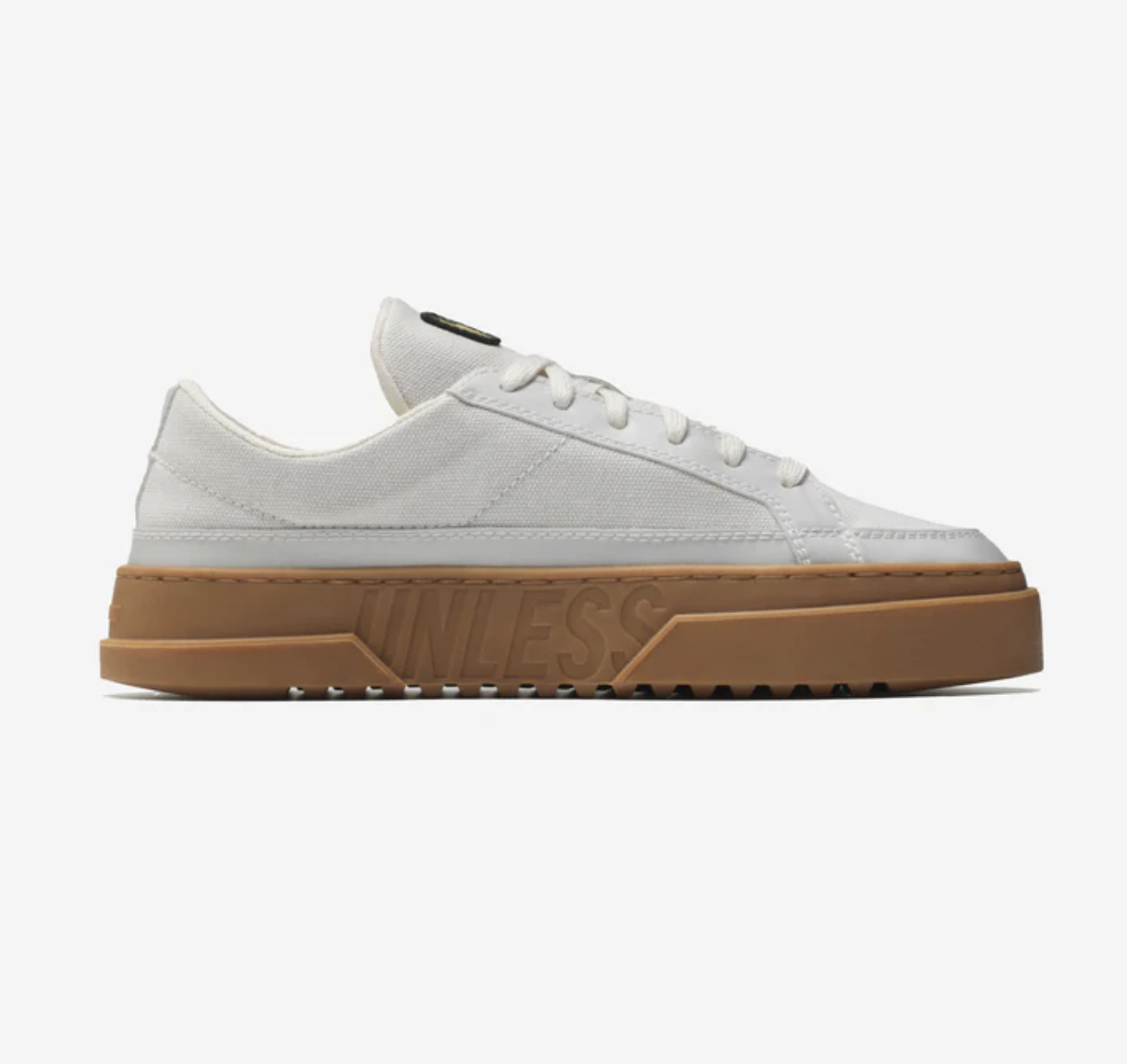
It is made from:
- MIRUM® (a natural, plant-based leather)
- TUNERA™ and PLIANT™ (natural-rubber foams and outsoles)
- Cotton, linen, and coconut fiber components
When returned at end-of-life, the shoe is designed to biodegrade safely in controlled composting, returning to the earth without leaving microplastics or toxins behind.
It is an extraordinary step forward, though still a niche lifestyle shoe rather than a high-performance trainer. Still, it proves what is possible when you start from the premise that plastic is not an option.
Recycling Versus Re-Creating
Many brands currently use recycled plastic bottles or ocean waste to create sneaker uppers. This helps by keeping existing plastics in circulation and reducing virgin production, but it also recycles the problem.
Recycled plastic still breaks down into microplastics over time, and most “recycled” sneakers will still end up in landfill. True progress means moving beyond plastic altogether, not just extending its lifespan.
The future lies in regenerative design; materials that safely return to nature or can be reused infinitely without toxins or fossil inputs.
Decoding 10 Common Sustainability Claims
As sustainability has become a selling point, so have buzzwords.
Here’s what some of the most common claims actually mean:
🌱 Vegan
No animal materials - but often made with plastics.
(Tip: “Vegan” doesn’t automatically mean eco-friendly.)
🤝 Fair Trade
Refers to certified ethical labor standards and fair pay.
Check for credible certification; the label alone isn’t always proof.
🌍 Carbon Neutral or Carbon Negative
Carbon neutral means emissions are balanced through offsets or removals.
Carbon negative means the brand removes more carbon than it emits.
Always check transparency and what’s included in their accounting.
♻️ Zero Waste
Aims for minimal or no production waste such as offcuts or scraps.
It doesn’t necessarily include what happens at the end of a product’s life.
🔄 Take-Back Program
You can return used products for recycling or composting.
Some programs truly repurpose items, others simply downcycle them; look for details.
🧵 Recycled Content
Uses waste materials (like plastic bottles or textile scraps) instead of virgin resources.
It’s better than new plastic but still part of the same problem if the base material is synthetic.
🌾 Organic
Grown without synthetic pesticides or fertilizers. Usually applies to cotton or natural fibers.
It doesn’t cover glues, foams, or dyes unless stated.
🍃 Plant-Based
Made mostly from renewable plants such as hemp, cork, or natural rubber.
Adhesives or coatings may still contain synthetics.
💚 Give-Back Program
Donates a portion of proceeds to a social or environmental cause.
It’s positive, but not a substitute for true systems change in materials and production.
🌸 Biodegradable or Compostable
Can break down naturally into safe elements like water, biomass, and CO₂ within certain conditions.
Be aware that many “biodegradable” materials require industrial composting to fully decompose.
✨ Look for brands that combine several of these principles - for example, plant-based and circular design - and that publish transparent lifecycle data.
What You Can Do
Sustainability is not about perfection; it is about direction. Every choice adds up.
Here are small steps that make a big difference:
- Buy less and buy better. Quality sneakers that last longer reduce waste.
- Repair or resole before replacing.
- Support plastic-free innovators like Unless Collective or other natural-material pioneers.
- Ask questions. How is it made? What happens at the end of its life?
- Be wary of greenwashing. “Recycled” does not always mean “sustainable.”
- Advocate for better systems. Community composting, textile recycling, and brand accountability are key to real change.
— GQ, “The Race for Sustainable Sneakers”
The Bottom Line
Making a sustainable sneaker is one of fashion’s toughest challenges. It means undoing decades of design built on cheap, durable plastics and re-imagining everything from materials to end-of-life systems.
But innovation is happening. From banana and pineapple fibers to mushroom leather and carbon-capture textiles, the future of footwear is being re-engineered in real time.
The question is not if sneakers can become sustainable, but when.
And the answer depends on all of us - designers, consumers, and the industry alike, stepping forward, one footprint at a time.
Brands Leading the Change
A new generation of designers and companies is proving that sustainability is not just about materials, but mindset. The movement is being shaped by a new generation of brands proving that sustainability is not just about materials, but mindset. In the next piece, we’ll look at the ones leading the way.
👉 Read the full feature: 10 Brands Redefining the Future of Sustainable Sneakers